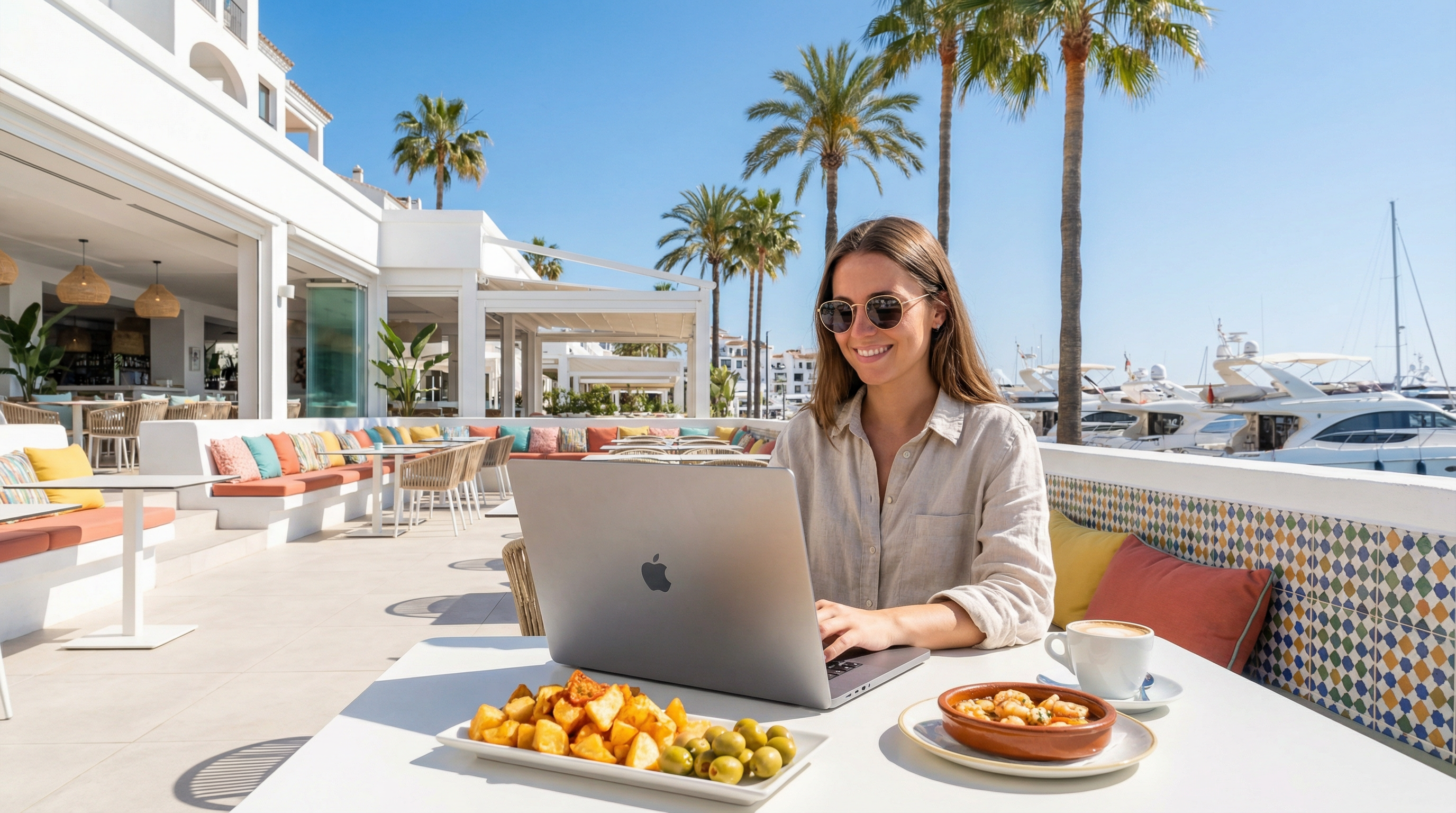
The Costa del Sol attracts digital nomads for its year-round sun, fast fiber internet, major-airport connectivity, and a clear legal path via Spain’s Digital Nomad Visa. In 2026, it makes sense if you value lifestyle plus compliance: pick the right area, confirm your visa and tax position, and secure long-stay housing with reliable Wi‑Fi.
We’ve watched the Costa del Sol evolve from a holiday coast into a serious digital nomad and remote work base. Over the years, we’ve helped hundreds of professionals set up compliant, comfortable lives here—balancing sunshine with solid infrastructure. If you’re deciding whether 2026 is your year, this guide gives you the practical answers we give our clients over coffee in Puerto Banús.
Why are digital nomads choosing the Costa del Sol in 2026?
Three drivers keep coming up in our client calls: lifestyle, connectivity, and legality. You get 300+ days of sun, fast fiber, and direct flights across Europe. On top of that, Spain’s Digital Nomad Visa formalized a compliant path for non‑EU remote workers to live and work from here [CITATION_NEEDED: BOE Ley 28/2022 Startup Law].
Quality-of-life advantages you’ll feel daily
The Costa del Sol blends beach walks with mountain hikes, modern gyms, and year‑round padel and golf. Cafés open early, and co‑working hubs stretch across Marbella, Málaga, Estepona, Fuengirola, and Mijas. Families appreciate international schools and safe neighborhoods [INTERNAL_LINK: family relocation to Costa del Sol schools and healthcare].
- Stable climate for daily routines and outdoor work breaks
- Diverse food scene with great value weekday menus
- Multilingual services and international communities
Connectivity that supports serious work
Spain leads Europe in fiber-to-the-home deployment, and gigabit coverage is extensive along the Costa del Sol, enabling stable calls and backups [CITATION_NEEDED: European Commission DESI Spain broadband 2023]. Málaga–Costa del Sol Airport offers dense European and seasonal long‑haul routes, making client travel feasible [CITATION_NEEDED: AENA Málaga-Costa del Sol airport statistics].
- Fast fiber in most urban coastal areas; 5G in key zones
- Dozens of co‑working spaces from Málaga to Marbella [INTERNAL_LINK: best coworking spaces Costa del Sol]
- Timezone overlap with Europe, Africa, and parts of the Americas
Is the Costa del Sol good for remote work long term?
For most professionals we advise, yes—if you plan for compliance and choose the right area for your routines. The Costa del Sol rewards medium- to long‑stay living more than quick hops. Reliable housing, legal clarity, and local support make the difference between a holiday and a sustainable base.
What makes it sustainable beyond the first year
You’ll find predictable internet, stable tenancy options, and a clear path to renew visas or regularize EU residence. International schools and healthcare networks support families. Business networking, tech meetups, and Málaga’s startup scene keep your professional energy high.
- Coherent routine: gym, co‑work, beach, and evening networking
- Professional services: English‑speaking lawyers, tax advisors, doctors
- Housing stock from modern new‑builds to village houses [INTERNAL_LINK: long-stay rentals in Marbella and Estepona]
Common pitfalls to avoid
Short‑term thinking is expensive. We see newcomers overpay for monthly rentals, ignore visa timing, or overlook tax residency rules. Set your legal base first, negotiate housing second, and then layer lifestyle choices thoughtfully.
- Confirm visa eligibility before travel if non‑EU
- Don’t rely solely on seasonal Airbnbs; seek 10–12‑month terms
- Clarify tax residency and social security from day one [INTERNAL_LINK: tax planning for expats in Spain]
Can digital nomads live here legally? Visas, compliance, and timelines
Yes—both EU and non‑EU nationals have clear paths. EU citizens can reside and work freely, with registration required beyond 90 days [CITATION_NEEDED: Ministerio del Interior EU citizen registration]. Non‑EU remote workers can apply for Spain’s Digital Nomad Visa under the Startup Law framework [CITATION_NEEDED: BOE Ley 28/2022 Startup Law].
Legal pathways at a glance
For EU/EEA/Swiss citizens: register your EU residence if staying over three months, obtain your NIE, and register on the municipal padrón [CITATION_NEEDED: Ministerio del Interior EU citizen registration]. For non‑EU: the Digital Nomad Visa (teletrabajo) enables residence while working for foreign companies or clients [CITATION_NEEDED: Ministerio de Inclusión y Seguridad Social guidance].
- NIE number for contracts, utilities, and banking [INTERNAL_LINK: how to get an NIE number in Spain] [CITATION_NEEDED: Policía Nacional NIE]
- Municipal registration (padrón) for local services [CITATION_NEEDED: Ayuntamiento de Marbella padrón]
- Private health insurance required for most non‑EU visas [CITATION_NEEDED: Consulate of Spain visa requirements]
Typical Digital Nomad Visa requirements
Expect to prove remote income above a set threshold, a clean background, private health coverage, and proof of accommodation. Processing often takes 3–8 weeks depending on consulate or in‑Spain applications [CITATION_NEEDED: Consulate of Spain visa processing times]. Income thresholds have been linked to multiples of Spain’s minimum wage (SMI) [CITATION_NEEDED: BOE Ley 28/2022 Startup Law].
- Work contract or client agreements proving remote work
- Financial means above required minimums
- Background check and health insurance without copays
Social security and tax compliance
If your employer is abroad, confirm social security coverage. EU posted workers can use the A1 certificate; others may need local affiliation or private coverage depending on visa terms [CITATION_NEEDED: European Commission Your Europe A1]. Tax residency is usually 183+ days; Spain has double‑tax treaties to avoid double taxation [CITATION_NEEDED: Agencia Tributaria tax residency 183 days] [CITATION_NEEDED: Agencia Tributaria double tax treaties].
- Consider Spain’s inbound “Beckham” regime if eligible (flat rates, up to six years) [CITATION_NEEDED: Agencia Tributaria impatriate regime]
- Coordinate payroll/tax with your employer/client structure
- Get written advice before arrival [INTERNAL_LINK: tax planning for expats in Spain]
Where should remote workers live? Best areas by lifestyle and budget
Different pockets of the coast fit different work rhythms. In our experience, picking the right micro‑location determines 80% of your daily satisfaction. Start with your priorities: walkability, schools, budget, vibe, and commute time to the airport.
Marbella: premium lifestyle and polished services
Marbella suits executives, founders, and families who value high‑end amenities and international schools. You’ll find top gyms, medical clinics, private communities, and reliable fiber. Expect higher rents near the Golden Mile and Puerto Banús.
- Pros: mature services, upscale housing, international community
- Consider: higher costs, traffic at peak hours
- Explore: Nueva Andalucía, Sierra Blanca, San Pedro [INTERNAL_LINK: neighborhoods comparison Marbella vs Estepona vs Mijas]
Estepona: relaxed, modern, and growing fast
Estepona mixes a charming old town with new‑build communities, great promenades, and family‑friendly neighborhoods. Many clients choose it for better value than Marbella with near‑equal comfort.
- Pros: newer developments, excellent promenades, strong value
- Consider: longer drive to Málaga airport than Fuengirola/Málaga
- Explore: Cancelada, El Paraíso, Seghers [INTERNAL_LINK: long-stay rentals in Marbella and Estepona]
Málaga City: urban energy and startup scene
Málaga offers museums, a walkable center, and the densest flight options. Coworking choices abound, and the tech scene is lively. It’s great for singles and couples who thrive on city energy.
- Pros: top connectivity, culture, many co‑works
- Consider: compact apartments in the historic center
- Explore: Soho, El Limonar, Teatinos
Fuengirola, Benalmádena, Mijas: practical and connected
These towns balance value, beach life, and good rail access to Málaga city and airport. We place many first‑year nomads here for convenience and community.
- Pros: value, train to airport, lively year‑round
- Consider: touristy strips near the beachfront
- Explore: Los Boliches, Carvajal, Mijas Costa
Marinas and villages: specific niches
Puerto Banús is high‑energy and social; La Cala de Mijas feels village‑cozy; Benahavís offers peace and golf‑course living. If calls and deep work dominate, consider quieter hills with strong fiber.
- Pros: tailored vibes for different lifestyles
- Consider: car dependence in some hillside areas
- Check: fiber availability building‑by‑building [INTERNAL_LINK: best coworking spaces Costa del Sol]
Costs, housing, and an action plan to get set up
For BOFU readers, here’s the practical path we use with clients. Secure legality, confirm budget, then lock housing that supports your work. If you’re exploring ownership, we’ll flag flexible paths too.
Step‑by‑step timeline (8–12 weeks, typical)
Week 1–2: Eligibility check and documents. Confirm EU or non‑EU route, income proofs, insurance, and background checks [CITATION_NEEDED: Consulate of Spain visa requirements]. Week 3–6: Submit visa or EU registration plan; apply for NIE [CITATION_NEEDED: Policía Nacional NIE]. Week 5–8: Pre‑select neighborhoods and rentals; verify fiber.
- Week 6–10: Sign 10–12‑month rental; register padrón [CITATION_NEEDED: Ayuntamiento de Marbella padrón]
- Week 8–12: Set up banking, co‑working, and childcare/schools
- Parallel: Tax and social security positioning [INTERNAL_LINK: tax planning for expats in Spain]
Housing options and negotiation tips
Long‑stay rentals (10–12 months) are the sweet spot for digital nomads. Ask for speed tests, smart‑home features, and an office‑ready room. In new‑build communities, ensure the community fiber and 5G coverage are active, not just planned.
- Negotiate furnished vs. unfurnished terms and Wi‑Fi included
- Seek dual‑aspect ventilation for summer comfort
- Ask for a professional cleaning before move‑in
Sample monthly budget ranges (guidance only)
As a planning baseline, our clients typically allocate: housing, co‑working, transport, groceries/dining, and insurance. Rents vary by micro‑location and season; confirm current rates via official indices and local market checks [CITATION_NEEDED: MITMA rental housing index Andalucía].
- Housing: varies widely by town and proximity to beach
- Coworking: day passes or monthly memberships based on usage
- Utilities, mobile/5G backup, and insurance add predictability
Considering ownership or rent‑to‑own
If you foresee 3–5 years here, ownership can be efficient. Many clients start with a long‑stay rental, then buy a new‑build off‑plan with staged payments or a resale after a test year [INTERNAL_LINK: buying a home in Spain as a remote worker]. Explore financing and non‑resident criteria early [INTERNAL_LINK: mortgage options for non-residents Spain].
- Run a buy‑vs‑rent analysis for 3–7‑year horizons
- Inspect building fiber and mobile coverage before buying
- Model running costs and community fees with prudence
Taxes, social security, and staying compliant
We prioritize compliance from day one. It’s not glamorous, but it’s what lets you work calmly at 9 a.m. on a Tuesday with the sea in view. Map your residency, income sources, and social security position before moving.
Tax residency and double taxation
Spain treats you as tax resident if you spend 183+ days in a calendar year or have your main economic interests here [CITATION_NEEDED: Agencia Tributaria tax residency 183 days]. Spain maintains double‑tax treaties to reduce or eliminate double taxation—align with a professional advisor for filings [CITATION_NEEDED: Agencia Tributaria double tax treaties].
- Track days and ties (home, spouse/children, economic center)
- Use treaty rules where applicable; maintain documentation
- Avoid accidental residency by planning travel and contracts
Inbound regime (“Beckham law”)
Eligible newcomers may opt into Spain’s impatriate regime for a fixed period, potentially applying flat rates to employment income from Spanish sources, subject to conditions [CITATION_NEEDED: Agencia Tributaria impatriate regime]. This can be attractive for remote employees; independent contractors should confirm eligibility carefully.
- Assess eligibility windows and filing deadlines
- Model scenarios with and without the regime
- Coordinate with employer payroll where relevant
Social security and health coverage
EU posted workers request an A1 certificate to keep paying into their home system [CITATION_NEEDED: European Commission Your Europe A1]. Non‑EU visa holders typically need private health insurance; long‑term residents may access regional systems or special contribution schemes [CITATION_NEEDED: Consulate of Spain visa requirements].
- Maintain proof of coverage in Spanish or certified translation
- Register on the padrón to access local services [CITATION_NEEDED: Ayuntamiento de Marbella padrón]
- Consider backup travel health cover for frequent flyers
2026 outlook: market trends, our take, and what it means for you
From our vantage point, demand from remote workers remains resilient, especially in well‑connected locations with modern builds. Málaga’s tech momentum and the coast’s maturing services point to steady long‑stay demand rather than speculative spikes.
What we’re seeing on the ground
High‑quality rentals with dedicated workspaces and strong fiber move fast. New‑build communities that deliver reliable internet and energy efficiency remain in demand. Coworking operators continue to open satellite spaces along the coast to match hybrid teams.
- Proximity to train stations and airport routes matters
- Energy‑efficient homes lower summer cooling costs
- Community amenities (meeting rooms, quiet pods) add value
Does Costa del Sol still make sense in 2026?
Yes—if you prioritize compliance, choose the right area, and negotiate well. For EU citizens, it’s a straightforward lifestyle upgrade. For non‑EU professionals, the Digital Nomad Visa provides a legal channel; align taxes and social security early to avoid surprises [CITATION_NEEDED: BOE Ley 28/2022 Startup Law].
- Anchor your plan with a 12‑month view, minimum
- Lock in a home that supports deep work, not just holidays
- Build a local support team: legal, tax, and property [INTERNAL_LINK: tax planning for expats in Spain]
Expert tips from our team
After years guiding international remote workers, a few habits predict success. Think like a resident from day one, not a tourist. Invest early in the systems—banking, internet, workspace—that keep your workday smooth.
- Run a one‑week “work trial” in your chosen neighborhood before signing
- Keep a 5G hotspot as a backup to fiber
- Ask landlords for proof of speed tests and ISP redundancy
- Document everything for visa renewals and tax filings
- Join one professional community within the first month
FAQs we’re asked most
Is the Costa del Sol good for remote work? Yes—fast fiber, co‑works, and flight connectivity support serious work. Can digital nomads live here legally? EU: register; Non‑EU: Digital Nomad Visa under Ley 28/2022 [CITATION_NEEDED: BOE Ley 28/2022 Startup Law]. Which areas are best? Marbella for premium, Málaga for urban, Estepona for value, and Fuengirola/Mijas for convenience.
- How long should I plan for setup? Typically 8–12 weeks from paperwork to settled housing.
- Do I need an NIE? Yes, for contracts and banking [CITATION_NEEDED: Policía Nacional NIE].
- What about schools? The coast has multiple international options; start applications early [INTERNAL_LINK: family relocation to Costa del Sol schools and healthcare].
- Should I rent or buy first? We suggest a 10–12‑month rental, then reassess ownership [INTERNAL_LINK: buying a home in Spain as a remote worker].
Next steps: make your 2026 move with confidence
If you’re ready to relocate or set up a long‑stay base, we’ll help you sequence visas, housing, and daily logistics. We’ve guided 500+ international families and professionals through this journey—calmly and compliantly.
Start with a clarity call. We’ll map your eligibility, shortlist areas, and arrange viewings—plus introduce vetted legal and tax partners. When you land, your Wi‑Fi, desk, and first grocery shop should already be waiting. That’s how you start strong on the Costa del Sol. [INTERNAL_LINK: cost of living breakdown Costa del Sol 2026] [INTERNAL_LINK: guide to the Spanish digital nomad visa]