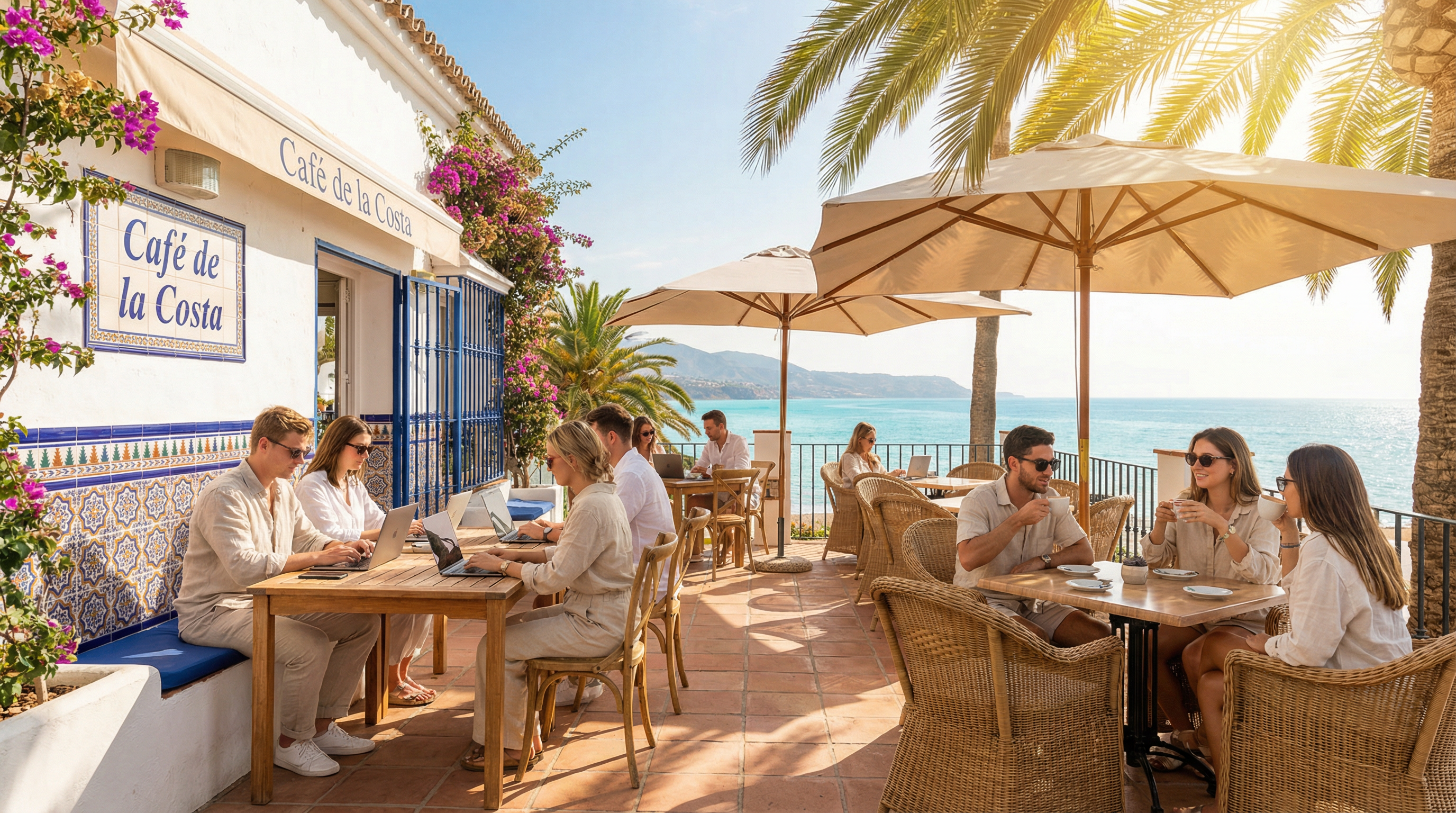
Digital nomads choose the Costa del Sol for its 300+ sunny days, fast fiber internet, direct flights via Málaga (AGP), and a legal path to live and work (EU freedom of movement and Spain’s Digital Nomad Visa). In 2026 it makes sense if you plan compliance, budget smartly, and pick the right area for your lifestyle.
We’ve watched the Costa del Sol transform from a holiday coast to a year-round, work-friendly hub. In our daily work between Marbella, Estepona, Fuengirola, Benalmádena, and Mijas, we see remote professionals thriving: reliable fiber, cafés that open early, and communities that make settling in easy. If you’re weighing a long-stay move in 2026, this guide combines lived experience with hard facts: the best areas, real costs, legal pathways, and practical steps. Our goal is simple: help you decide with clarity and confidence, without the hype. Grab a coffee—let’s map out your plan.
Why the Costa del Sol Works for Remote Work in 2026
The draw is a balance of climate, connectivity, and compliance. Málaga Airport links you to Europe’s capitals year-round, often with same-day returns for client meetings [CITATION_NEEDED: AENA route and traffic statistics]. Fiber-to-the-home coverage across Málaga province exceeds 90% in urban zones, with 600 Mbps–1 Gbps common in coastal towns [CITATION_NEEDED: Spanish broadband coverage statistics].
Legally, EU citizens can live and work freely; non-EU remote workers typically use Spain’s Digital Nomad Visa (under the 2022 Startup Law), which also opens access to the special expat tax regime for eligible employment income [CITATION_NEEDED: BOE Law 28/2022]. Healthcare, schools, and a multilingual service ecosystem round out the foundation.
In our experience helping hundreds of families, the quality-of-life upside is real: morning swims, school runs without stress, and late-afternoon sun even in January. But success hinges on choosing the right area and getting the paperwork right from day one. That’s what we’ll unpack next.
Best Areas on the Costa del Sol for Remote Work
These five zones offer distinct trade-offs. We’ve included internet, commute, lifestyle, and typical long-stay rental ranges for 2-bedroom apartments (Q1–Q2 2026 estimates).
Marbella: Golden Mile, Nueva Andalucía, San Pedro
Marbella blends premium amenities with a strong international community. Coworking is plentiful, cafés are laptop-friendly, and most buildings have gigabit fiber. Expect 20–40 minutes to Málaga Airport off-peak and a mature services scene.
- Who it suits: Executives, entrepreneurs, creative teams.
- Rental guide: €1,800–€3,200/month depending on proximity to beach and parking.
- Pros: Top restaurants, private healthcare, schools, year-round buzz. Cons: Highest costs; seasonal traffic.
Estepona: Centro, Old Town, New Golden Mile
Estepona has blossomed into a polished, walkable town with fast internet, a family-friendly vibe, and quieter winters. Commute to AGP is about 50–60 minutes; many choose it for space and charm over speed.
- Who it suits: Designers, consultants, remote families seeking community.
- Rental guide: €1,400–€2,300/month. New builds with coworking rooms are common.
- Pros: Beautiful old town, promenade, value. Cons: Longer airport run, fewer late-night options.
Fuengirola: Center, Los Boliches, Carvajal
Fuengirola is the transport king: Cercanías (train) to the airport and Málaga city, walkable neighborhoods, and dense fiber coverage. It’s popular for those who want no-car living and easy city access.
- Who it suits: Employees with HQ trips, budget-savvy freelancers.
- Rental guide: €1,200–€1,900/month. Good stock near the train line.
- Pros: Train connectivity, everyday prices, beach life. Cons: Busy in summer, smaller homes.
Benalmádena: Arroyo de la Miel, Benalmádena Costa, Pueblo
Arroyo’s train station, steady coworking scene, and cafés make it a digital nomad staple. The Pueblo offers white-washed views and quieter streets; Costa has beachside pads. AGP is 15–25 minutes away.
- Who it suits: Mixed remote couples, first-time relocators.
- Rental guide: €1,100–€1,800/month. Reliable 600 Mbps fiber in most buildings.
- Pros: Quick airport access, value, variety. Cons: Hills, tourist pockets.
Mijas: La Cala de Mijas, Mijas Costa, Mijas Pueblo
La Cala feels like a friendly village with modern services. Mijas Costa has newer communities with pools and gyms; the Pueblo brings charm and cooler evenings. Driving to AGP takes 25–40 minutes.
- Who it suits: Remote families, wellness-focused professionals.
- Rental guide: €1,000–€1,700/month. Newer builds offer coworking lounges.
- Pros: Balanced costs, beach paths, international schools nearby. Cons: Car useful; some patchy cell signal on hills.
Anecdote: Last year we helped a Dutch–Canadian couple launch a remote design studio from Benalmádena. They chose Arroyo for the train, upgraded to 1 Gbps fiber in a week, and now split workdays between a home office and a seafront coworking lounge. Their take: “It’s easy to be productive—and still catch sunset.”
Costs and Budgeting for Remote Workers
Plan a realistic monthly budget per household for 2026. Long-stay rentals for 2-bed apartments range roughly €1,000–€3,200, depending on area, newness, and season. Expect an extra 10–20% premium for furnished, turnkey units near the beach in winter-high demand zones.
Utilities: Fiber 600 Mbps–1 Gbps averages €30–€55/month; mobile 5G plans with 100–200 GB data are €20–€35/month [CITATION_NEEDED: Spanish telecom pricing reports]. Coworking passes run €150–€350/month per seat. Car hire for long-term can be €350–€700/month; trains along the western coast reduce the need for a second car.
Groceries and eating out vary widely, but many remote couples target €600–€1,000/month for food. Private health insurance suitable for visas often starts from €50–€120/month per adult depending on age and coverage [CITATION_NEEDED: Insurer filings/regulatory data]. Keep a safety buffer equal to three months of living costs.
Legal Setup: Visas, Taxes, and Compliance
Legality matters. Spain’s Digital Nomad Visa (DNV) allows non-EU workers employed by or contracted to foreign companies to reside in Spain while working remotely. Requirements include clean criminal records, comprehensive health insurance, proof of qualifications, and income generally around 200% of Spain’s minimum wage (SMI) per month—consulate criteria can vary [CITATION_NEEDED: Ministry/Consulate DNV guidance].
Many DNV holders can elect Spain’s special expat tax regime (popularly “Beckham regime”), taxing eligible employment income at 24% up to a threshold and simplifying foreign income handling, subject to conditions and timelines [CITATION_NEEDED: BOE Law 28/2022 implementing regulations]. EU/EEA citizens relocate under freedom of movement, registering residence locally if staying beyond 90 days [CITATION_NEEDED: Spanish immigration guidance].
Visa and Tax Steps (Non-EU)
Follow a clear sequence and document thoroughly.
- 1) Check DNV eligibility and employer remote-work letter; confirm majority foreign-sourced income [CITATION_NEEDED: DNV eligibility criteria].
- 2) Apply at a Spanish consulate or in Spain (where allowed); prepare translations/apostilles.
- 3) Obtain your NIE (foreign ID number) and register your address (padrón) after arrival [CITATION_NEEDED: Ayuntamiento padrón rules].
- 4) Elect the special expat tax regime within the deadline if eligible [CITATION_NEEDED: Tax agency procedure].
- 5) Clarify social security: EU A1 portability vs. Spanish registration for non-EU scenarios [CITATION_NEEDED: EU Regulation 883/2004 guidance].
Insider note: Timelines vary by consulate and season. We see 4–12 weeks for DNV approvals. Build wiggle room into lease start dates and school planning.
EU Citizens: Simple but Not “Automatic”
EU movers still need to sort NIE, local registration, and healthcare coverage. If you plan to stay long-term, register your residence and update tax residency status to avoid double taxation surprises [CITATION_NEEDED: AEAT residency rules].
We often recommend a 60–90 day “soft landing” rental while your paperwork finalizes. It reduces stress if appointments slip.
Practical Setup: Housing, Internet, and Daily Life
Arrive with a plan for your first 30 days. A furnished long-stay rental near a supermarket, gym, and train (where available) makes onboarding smoother. In Andalucía, landlords typically lodge the legal deposit with the regional authority, and contracts follow Spain’s urban leasing law for long-term rentals [CITATION_NEEDED: Junta de Andalucía deposit, LAU rules].
30–60 Day Setup Checklist
Use this as your quick-start map.
- 1) Secure NIE and register on the padrón with your lease [INTERNAL_LINK: NIE number in Spain step-by-step] [CITATION_NEEDED: Ayuntamiento padrón rules].
- 2) Open a Spanish bank account for utilities and rent [INTERNAL_LINK: Spanish bank account for expats].
- 3) Contract fiber internet (600 Mbps–1 Gbps) and a 5G mobile plan; ask for a router with Wi‑Fi 6.
- 4) Choose a coworking plan or fit out a home office with an external monitor and ergonomic chair [INTERNAL_LINK: best coworking spaces Costa del Sol].
- 5) Sort healthcare (private policy for DNV; EU card or public coverage if eligible) [CITATION_NEEDED: Spanish healthcare access rules].
- 6) If driving, exchange your license where needed and understand Zona Azul/Parking norms [CITATION_NEEDED: DGT license exchange guidance].
- 7) For families, shortlist schools and book campus tours early [INTERNAL_LINK: schools and education Costa del Sol guide].
Finding the Right Rental
Set a clear brief: budget, commute time to AGP, need for a car, top-floor vs. ground-floor, and noise tolerance. Ask for a speed test screenshot and check mobile reception in the unit. If you plan year-round, negotiate shoulder-season rates.
For 6–12 month stays, focus on long-term contracts under the LAU, not holiday lets. We can pre-screen listings and secure video tours to save you time [INTERNAL_LINK: long-term rentals Costa del Sol guide].
Market Insights 2026: Rentals, Flights, Infrastructure—Plus Our Tips
Rental supply is seasonally tight in Q3 but improves in Q4–Q1, especially in Benalmádena and Fuengirola. New-build communities adding shared work lounges are expanding along Mijas Costa and Estepona’s New Golden Mile. Expect stable demand from hybrid workers who split time between HQ and Málaga [CITATION_NEEDED: Municipal statistics/new-build permits].
Flights remain a major advantage. Málaga (AGP) continues to service a broad European network with winter schedules to key hubs; this reduces the “distance tax” for client visits [CITATION_NEEDED: AENA winter schedules]. Broadband rollouts keep improving hilltop coverage while coastal corridors already enjoy dense FTTH [CITATION_NEEDED: National broadband plan updates].
Does a move make sense long term? For many, yes—if you keep compliance tight and pick an area aligned to your daily rhythm. Medium-term, we expect steady rents in train-linked towns and moderate growth in premium Marbella zones.
Expert Tips from the Front Line
Here’s what we advise clients after thousands of viewings and negotiations.
- 1) Prioritize proximity: If you fly monthly, stay within 10–15 minutes of a train or direct highway access to AGP.
- 2) Test internet before signing: Run a live speed test in the flat. Ask the building administrator about fiber providers.
- 3) Protect your timeline: Start DNV and NIE processes first; then lock your lease start date to your arrival window [INTERNAL_LINK: digital nomad visa Spain requirements].
- 4) Budget beyond rent: Add 15% for utilities, coworking, and transport to avoid squeeze months.
- 5) Think resale or exit: If you’re eyeing flexible ownership, target liquid micro-locations—near beaches, train, or lively town centers [INTERNAL_LINK: buying property process in Andalusia].
- 6) Mortgage reality check: Non-resident LTVs are often lower; plan a higher down payment if you buy later [INTERNAL_LINK: mortgage options for non-residents Spain].
- 7) Tax clarity first: Align your tax residency, social security, and corporate structure before day one in Spain [CITATION_NEEDED: AEAT tax residency guidance].
FAQs
Why do digital nomads choose the Costa del Sol?
Sun, flights, fast internet, and an international community. The legal pathway via the Digital Nomad Visa and straightforward EU mobility add certainty, while year-round amenities make day-to-day life practical [CITATION_NEEDED: BOE Law 28/2022; AENA; broadband coverage data].
Can digital nomads live on the Costa del Sol legally?
Yes. Non-EU professionals commonly use Spain’s Digital Nomad Visa; EU/EEA citizens move under freedom of movement. You’ll still handle NIE, local registration, and tax/healthcare steps to be compliant [CITATION_NEEDED: Spanish immigration and tax agency guidance].
Which areas are best for remote workers?
Marbella for premium amenities; Estepona for charm and space; Fuengirola for train connectivity; Benalmádena for value and proximity to AGP; Mijas for balanced living with newer communities. Your choice depends on budget and travel needs.
How much should I budget monthly?
Most remote couples plan €2,500–€4,500/month including rent, utilities, coworking, transport, and insurance, with wide variance by area and lifestyle. Build a three-month buffer to absorb seasonality and setup costs.
Is buying property sensible if I’m remote?
It can be, if you value stability and choose liquid micro-locations. Factor in purchase costs and local taxes in Andalucía and keep a long horizon. If unsure, rent for 6–12 months first [INTERNAL_LINK: Andalucía property taxes 2026].
Conclusion: Does Remote Work on the Costa del Sol Make Sense in 2026?
If you want sunshine, strong connectivity, and a legal base in the EU, the Costa del Sol delivers. It works best when you align your area with your travel pattern, set a realistic budget, and get the paperwork right early. We’ve helped hundreds of professionals do this smoothly.
Ready to explore neighborhoods, rental options, or a flexible ownership plan? Tell us your budget, flight habits, and must-haves. We’ll shortlist areas and set up a compliant onboarding plan—NIE, banking, internet, and a workspace—so you can land, log in, and get to work.