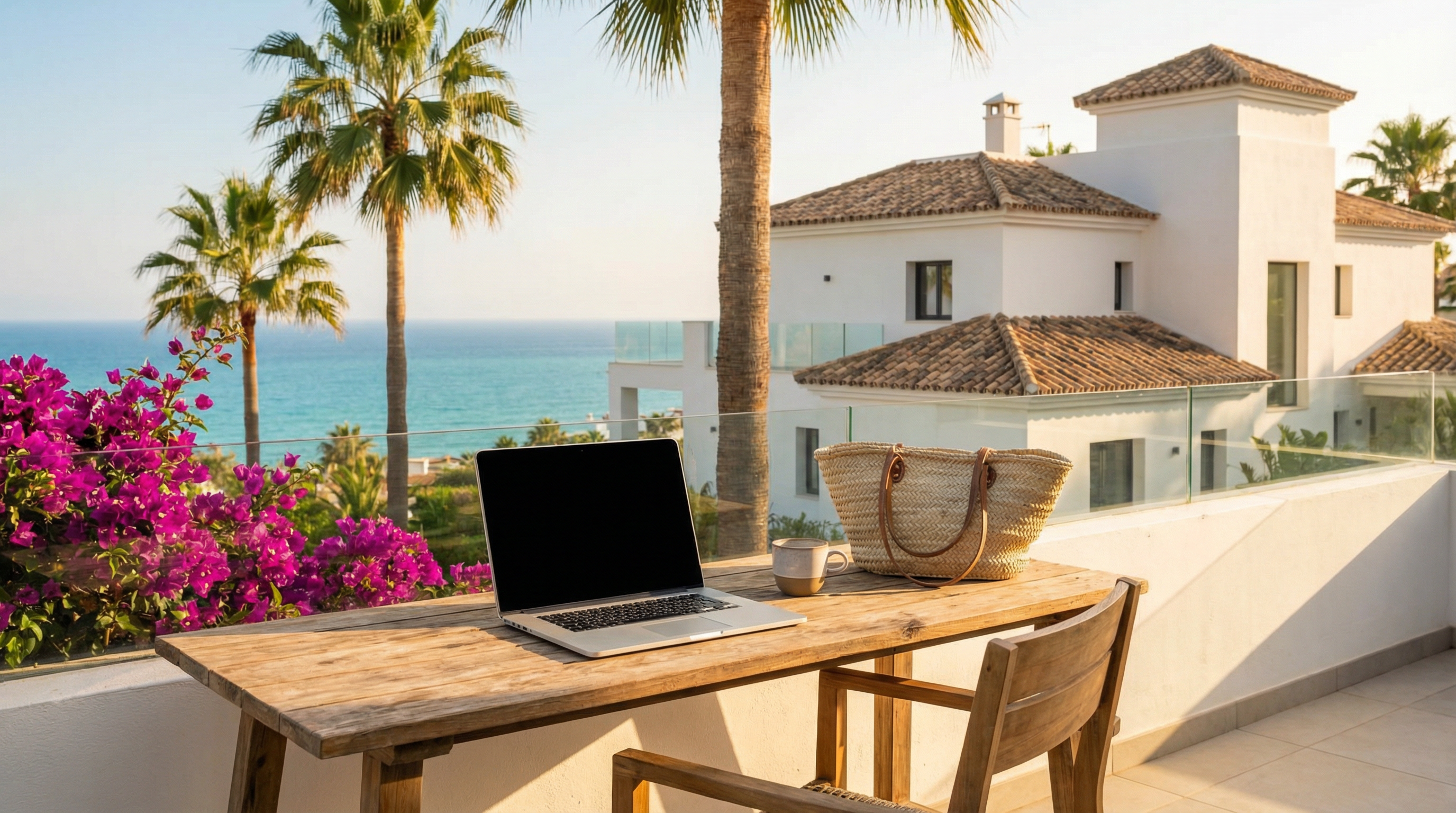
The Costa del Sol offers digital nomads a rare mix of year-round sun, fast fiber internet, a major international airport, and thriving English-speaking communities. With Spain’s Digital Nomad Visa, compliant tax options, and diverse neighborhoods from Málaga to Marbella, it’s a practical, lifestyle-rich base that can work long term if you plan legally and budget smartly.
We’ve welcomed hundreds of remote professionals who came for sunshine and stayed for the balance: a deep talent pool, reliable infrastructure, and an easy rhythm of life. From beachfront runs before stand-ups to evening tapas with fellow founders, working remotely on the Costa del Sol isn’t a fantasy — it’s operationally sound if you set it up right. Here’s how to decide if 2026 is your year.
Why are digital nomads choosing the Costa del Sol in 2026?
In our experience, the Costa del Sol hits the sweet spot between lifestyle and logistics. You get 300+ days of sun, fiber-to-the-home across most coastal towns, and co-working hubs that make onboarding painless. Málaga Airport connects you to Europe and hubs beyond, often with direct flights year-round [CITATION_NEEDED: AENA Málaga traffic and routes].
Equally important, Spain formalized a clear legal path for remote workers via the Startup Law and Digital Nomad Visa, reducing the grey areas many of you want to avoid. Add in stable time zones for EU clients and reachable US overlaps, and you’ve got a location that “just works” for distributed teams [CITATION_NEEDED: Spanish Startup Law 28/2022 overview].
Core reasons professionals relocate
We hear the same triggers again and again: escaping long winters, finding a family-friendly base with schools and healthcare, and replacing long commutes with ocean views. Beyond mood, productivity rises here — fewer urban stressors, more outdoor hours, and a community that balances ambition and wellbeing.
- Dependable internet (symmetrical 300–1,000 Mbps common) in main municipalities [CITATION_NEEDED: Government broadband coverage Andalusia].
- International education and private healthcare options for families [CITATION_NEEDED: Junta de Andalucía education and health portals].
- Vibrant co-working, meetups, and founders’ networks in Málaga, Marbella, and Fuengirola.
Who thrives here — and who might not
Entrepreneurs, consultants, tech leads, creatives, and remote employees on EU and non-EU contracts do especially well. If you need ultra-quiet global time zones with heavy Asia overlap, you may need to adjust work blocks. If you dislike mild seasonality in tourism, pick quieter enclaves outside peak zones.
- Choose neighborhoods a few streets back from the paseo for calmer nights.
- Use coworking season passes to pivot between busy beachfronts and quieter urban hubs.
- Consider shoulder-season travel to avoid summer price surges if renting short term.
What are the tangible benefits for remote workers?
The Costa del Sol’s benefits stack up across four pillars: lifestyle, infrastructure, legal clarity, and community. Most clients tell us their weekly schedule is smoother, not just sunnier. In 90 days you can set up your base, integrate into a community, and see gains in both output and wellbeing.
For many, the “softer” benefits are the tie-breaker: pre-work swims, weekend Sierra Blanca hikes, and a calendar filled with meetups rather than endless Uber rides. You’ll find more serendipity here — and that often leads to new clients and collaborations.
Lifestyle and time-zone advantages
Central European Time works for EU clients and gives a partial overlap with the US East Coast. Long daylight hours support split-shift routines: deep work mornings, afternoon pick-ups for families, evening client calls. It’s a flow we’ve seen boost sustained productivity.
- 300+ sunny days enable consistent outdoor fitness — a proven mood stabilizer.
- Safe, walkable neighborhoods reduce daily friction.
- Regional rail links make micro-retreats easy, from Ronda to Granada.
Infrastructure for remote work
Fiber penetration is strong across Málaga, Marbella, Fuengirola, Benalmádena, and Mijas. Co-working spaces are mature, with podcast booths, meeting rooms, and event calendars. Málaga Airport is Spain’s fourth-busiest, with frequent European links and long-haul connections via Madrid/Barcelona [CITATION_NEEDED: AENA Málaga stats].
- Routine home speeds: 300–600 Mbps; premium plans: 1 Gbps in many zones [CITATION_NEEDED: Spanish telecom coverage maps].
- Stable 4G/5G backup across urban stretches.
- Parcel lockers and courier networks for smooth e-commerce operations.
How can you live and work here legally — and stay compliant?
Legality matters. Spain’s Digital Nomad Visa (under Ley 28/2022) enables non-EU remote workers to reside while working for non-Spanish employers or clients, with clear income thresholds and documentation. EU/EEA citizens can reside freely but should register if staying longer term [CITATION_NEEDED: Spanish Startup Law 28/2022; EU citizen registration Spain].
Tax and social security depend on your status. Spain’s updated impatriate ("Beckham") regime can cap employment income tax at a flat rate if criteria are met. Social security detachment certificates (A1 for EU; Totalization for some countries) may apply for employees [CITATION_NEEDED: Agencia Tributaria expat regime; Seguridad Social postings/A1].
Visa paths and timelines
Non-EU digital nomad visas are applied for at consulates or in-country under specific conditions. Typical processing can range from several weeks to a few months, depending on workload and completeness. Expect consular fees plus document legalization costs [CITATION_NEEDED: Consular guidance for Digital Nomad Visa Spain].
- Core proofs: remote income, qualifications/experience, clean record, health insurance.
- Spouses/Children: family reunification options exist when eligibility is met.
- Residence card (TIE) issued locally after arrival and registration appointments.
Compliance checklist
We recommend a tight, sequenced setup to avoid penalties or double taxation. This is where many DIY movers slip up — usually on registration timing or incorrect tax assumptions. Work with qualified advisors rather than crowdsourced advice.
- NIE and municipal registration (padrón) where applicable [INTERNAL_LINK: how to obtain an NIE in Spain].
- Choose the right visa/residence path for your case [INTERNAL_LINK: Spain Digital Nomad Visa step-by-step guide].
- Tax residency analysis and impatriate regime assessment [INTERNAL_LINK: tax planning for remote workers in Spain].
- Health insurance coverage that meets residence criteria [INTERNAL_LINK: healthcare options for expats in Costa del Sol].
- Social security coordination (A1/Totalization) for employees [CITATION_NEEDED: EU social security coordination rules].
Which areas are best for remote workers — and why?
Every remote worker prioritizes differently: walk-to-everything urban living, seaside serenity, or kid-friendly suburbs with schools. We’ve matched hundreds of professionals to neighborhoods that fit their rhythm. Here’s a practical map from east to west.
These areas balance commute-free living with strong amenities, fast internet, and community. Most have co-working options nearby or fast rail/bus links for meetings across the coast.
Málaga City — urban energy and culture
Best for founders, designers, and teams that want a European city feel with beach access. Look at Soho, Centro Histórico (quieter side streets), and El Limonar. You’ll find galleries, tech meetups, and quick airport access. Consider soundproofing in older buildings.
- Walkable to cafes and coworking hubs.
- Fast city fiber and reliable 5G.
- Vibrant food culture for client dinners.
Marbella and Nueva Andalucía — premium live-work blend
Great for executives and families seeking villa privacy with international schools close by. Nueva Andalucía, Guadalmina, and San Pedro offer quiet streets, gyms, padel clubs, and enterprise-friendly services. You’ll meet global founders at coworking spots and networking breakfasts.
- Private clinics and schools at your doorstep.
- High-end rentals with dedicated offices.
- Strong expat community for quick integration.
Estepona — charming, walkable, and growing
Estepona’s center blends old town charm with modern amenities. It’s calmer than Marbella but increasingly cosmopolitan. Consider the new coastal areas east/west of town for modern builds with good insulation and parking.
- Family-friendly promenades and parks.
- Co-working and serviced offices expanding.
- Excellent value for quality finishes.
Fuengirola, Benalmádena, and Mijas — convenient and connected
Fuengirola offers great transport links and value, especially near Los Boliches and Carvajal. Benalmádena’s Arroyo de la Miel is lively, with easy rail to Málaga. La Cala de Mijas suits couples wanting a quiet base with strong beach life.
- Easy rail access to Málaga and the airport.
- Competitive rents versus Marbella center.
- Broad choice of cafés with reliable Wi-Fi.
How to choose your base
Match the area to your daily schedule. If you’ll host clients, prioritize parking and meeting rooms. If you’re noise-sensitive, avoid first-line nightlife. For families, map the school run first — you’ll thank yourself later.
- Test a month in two neighborhoods before committing long-term [INTERNAL_LINK: long-stay rentals in Costa del Sol].
- Ask ISPs to confirm actual speeds at the exact address.
- Check sun orientation if you hold late video calls to avoid glare.
How to set up your remote life: a step-by-step plan
In our playbook, 8–10 weeks is a realistic runway from decision to “fully operational.” Here’s a simple sequence that works for EU and non-EU professionals alike, with visa timelines added for non-EU applicants.
This plan avoids the common sequencing mistake: committing to long leases before securing paperwork. Keep flexibility until your residence and bank accounts are established.
Step 1: Define your compliance path
Confirm if you’ll use the Digital Nomad Visa, EU freedom of movement, or another residence route. Validate tax residency scenarios and social security obligations with a certified advisor before you move.
- Run a 12-month calendar to map days-in-country and tax residency risk [INTERNAL_LINK: residency days and tax rules Spain].
- Collect required visa documents and apostilles early [CITATION_NEEDED: Spanish consular document requirements].
Step 2: Secure accommodation and workspace
Start with a 1–3 month furnished rental near a coworking hub. Insist on written confirmation of fiber availability and a desk-friendly room. If you need parking or EV charging, lock it in upfront.
- Use video tours and speed tests during viewings.
- Ask for ergonomic chair and desk options; many landlords will accommodate.
Step 3: Essential registrations
Once in-country, get your NIE, open a bank account, and register your address if required for your residence process. Then apply for your TIE card appointment and complete biometric capture.
- NIE appointment and forms vary by province [INTERNAL_LINK: how to obtain an NIE in Spain].
- Banking: non-resident vs. resident accounts — choose based on your status [INTERNAL_LINK: opening a Spanish bank account guide].
Step 4: Optimize your tax and benefits
Assess the impatriate regime, deductible costs, and family status. Employees may retain home-country social security under A1 rules; contractors need separate advice on permanent establishment risks.
- Request written rulings where appropriate [CITATION_NEEDED: Agencia Tributaria binding rulings process].
- Coordinate with your employer/payroll for correct withholdings.
Step 5: Build your local network
Join coworking meetups, founders’ breakfasts, and skill-share groups. A strong local network accelerates projects and soft-lands families. We regularly introduce clients to trusted tax, legal, and schooling partners.
- Attend open house days at coworking spaces.
- Schedule quarterly check-ins on taxes, insurance, and residency status.
Legal, tax, and practical considerations you shouldn’t ignore
Compliance keeps your dream sustainable. The biggest risks we see are outdated advice and assumptions imported from other countries. Spain’s framework is clear enough, but the details matter — especially with cross-border income.
Use official guidance, not forums, for the rules that affect your status. Keep copies of every appointment receipt and certificate. It’s mundane, but it prevents headaches during renewals or audits.
Key legal points
Digital Nomad Visa holders typically work for non-Spanish entities and must meet income and background criteria. Some in-country conversions are possible, but document accuracy is essential. Family members can piggyback when eligibility is proven.
- Confirm health insurance meets policy specs for residence [CITATION_NEEDED: Spanish residence health insurance requirements].
- Keep police checks and apostilles within validity windows.
Tax and social security
Spain’s impatriate regime can offer a flat-rate benefit for qualifying employment income. Contractors and company directors have different tests. Employees seconded by foreign employers should verify A1 or Totalization coverage to avoid double contributions.
- Review double tax treaties for your home country [CITATION_NEEDED: Spain double taxation agreements list].
- Track physical presence days with an app — it’s evidence-friendly.
Housing, leases, and utilities
Seasonality influences pricing near the beach. Annual leases tend to stabilize costs and give tenant protections. Check for modern insulation, cross-ventilation, and afternoon shade if you hold late calls.
- Ask for utility bills to verify real energy costs.
- Confirm community rules for home offices and short-term guests [INTERNAL_LINK: long-stay rentals in Costa del Sol].
What does it cost — and how do you budget?
Costs vary by municipality and proximity to the sea. As a planning anchor, use 2024–2025 observed ranges, then add a sensible margin for 2026. Verify with current listings and our latest market brief before you commit.
In practice, your biggest variables are rent and private schooling. Co-working, transport, and groceries are predictable once you settle into a neighborhood routine.
Monthly budget scenarios (singles/couples)
Málaga City: One-bed apartments commonly range from roughly €950–€1,300 in central areas, with coworking from €120–€250. Marbella/Nueva Andalucía: Modern one-beds often €1,300–€1,800, with coworking from €150–€300. Estepona and Fuengirola offer competitive value versus Marbella core (ranges vary by exact zone) [CITATION_NEEDED: Official rental market statistics Andalusia].
- Utilities/internet: €90–€160 depending on season and plan.
- Private health insurance: €50–€150 per adult, age-dependent [CITATION_NEEDED: Spanish private health insurance regulators].
- Transport: €30–€120, depending on car vs. rail reliance.
Set-up timelines and deposits
Allow one to two months of rent as deposit, plus the first month upfront. Utility setup is fast with digital onboarding. Visa applicants should budget for document legalization, translations, and consular fees in addition to travel [CITATION_NEEDED: Spain consular fees schedule].
- Co-working passes are flexible — test a few before committing.
- Annual leases stabilize costs and reduce seasonality exposure.
What does the 2026 market look like for remote workers?
As of 2024, Málaga province was advancing in tech investment, airport connectivity, and broadband upgrades — a trajectory likely to keep benefiting remote professionals through 2026. Expect continued coworking growth and service ecosystems that cater to international families [CITATION_NEEDED: Junta de Andalucía digital strategy updates].
Seasonality will persist near tourist hotspots, but secondary neighborhoods continue to mature. If you want peak-summer quiet, choose slightly inland or east/west of main centers and close doors/windows during late-night fiestas — charming, but lively.
Resilience factors
The region’s diversified appeal — retirees, families, and professionals — keeps services stable year-round. Layers of transport (rail, highway, air) spread demand. That matters if you’re betting your business cadence on predictable living.
- Airport and rail upgrades bolster reliability [CITATION_NEEDED: AENA and ADIF project notes].
- Local governments continue digitalization and SME support programs.
Insider tips to get the balance right
We’ve seen the same playbook deliver smooth landings. Keep your first three months flexible, then commit once you’ve validated neighborhood, workspace, and routine. The right micro-choices will make your setup future-proof.
Don’t over-optimize for the beach alone. Proximity is great, but frequent context switching between home, coworking, and client meetings is the real unlock.
Practical recommendations
Pick a building with cross-ventilation and afternoon shade, especially for video calls. Bring a travel monitor and noise-canceling headset; add a standing desk if you’re on long sprints. If you host clients, a business-grade router and backup 5G hotspot are cheap insurance.
- Trial two coworkings: one social, one quiet.
- Use digital mailboxes if you hop between leases.
- Plan quarterly “deep work retreats” inland to reset.
Property strategy for semi-residents
If you plan 6–9 months per year here, consider a lock-up-and-leave apartment or townhouse with low community fees. For non-EU buyers considering future residency pivots, map options early and compare to long-stay renting [INTERNAL_LINK: flexible ownership options Costa del Sol].
- Non-resident mortgages are available with specific criteria [INTERNAL_LINK: mortgage options for non-residents Spain].
- Verify community rules on rentals if you’ll be away [INTERNAL_LINK: short-term rental regulations Andalusia].
FAQs: quick, clear answers for 2026
We’ve pulled together the questions we hear most from remote workers. Use these as a starting point, then get tailored advice for your exact profile and passport.
Our team and partners can help you validate the legal route, neighborhood fit, and budget before you book flights. It saves time and prevents expensive do-overs.
Is the Costa del Sol good for remote work?
Yes. You’ll find fast fiber, strong 4G/5G, and well-equipped coworking spaces across Málaga, Marbella, and surrounding towns. The airport offers excellent European connectivity, and English is widely spoken in professional settings [CITATION_NEEDED: AENA Málaga connectivity; broadband coverage Andalusia].
Can digital nomads live here legally?
EU citizens can reside under freedom of movement rules. Non-EU professionals often use Spain’s Digital Nomad Visa under the Startup Law, provided they meet income and documentation criteria. Always verify tax and social security implications before moving [CITATION_NEEDED: Law 28/2022; Agencia Tributaria guidance].
Which areas are best for remote workers?
Málaga (Soho, Centro, El Limonar) for urban life; Marbella/Nueva Andalucía for premium villas and schools; Estepona for charm and value; Fuengirola/Benalmádena/Mijas for great transport and affordability. Test at least two neighborhoods before committing [INTERNAL_LINK: best neighborhoods in Costa del Sol for remote work].
Does it make sense long term?
For many, yes — if you set up legally, choose the right neighborhood, and lock in an annual lease to avoid seasonality. Families appreciate schools and healthcare access, and professionals value the community and time zone advantages.
What are the common mistakes?
Signing long leases before securing paperwork, assuming tax rules from other countries apply, and underestimating seasonality near the first line. Sequence your setup and keep the first months flexible [INTERNAL_LINK: relocation checklist Costa del Sol].
Final thoughts — is the Costa del Sol the right move in 2026?
If you want a base where you can work deeply, live well, and grow your network, the Costa del Sol delivers. The infrastructure is there, the legal paths are formalized, and the lifestyle remains hard to beat. It makes sense — provided you do it by the book.
We’ve helped hundreds of remote professionals design compliant, low-friction setups from Málaga to Marbella. If you’d like a tailored plan — neighborhood shortlists, legal sequencing, and a clean budget — we’re here to help you land smoothly [INTERNAL_LINK: speak with a Costa del Sol relocation specialist].