
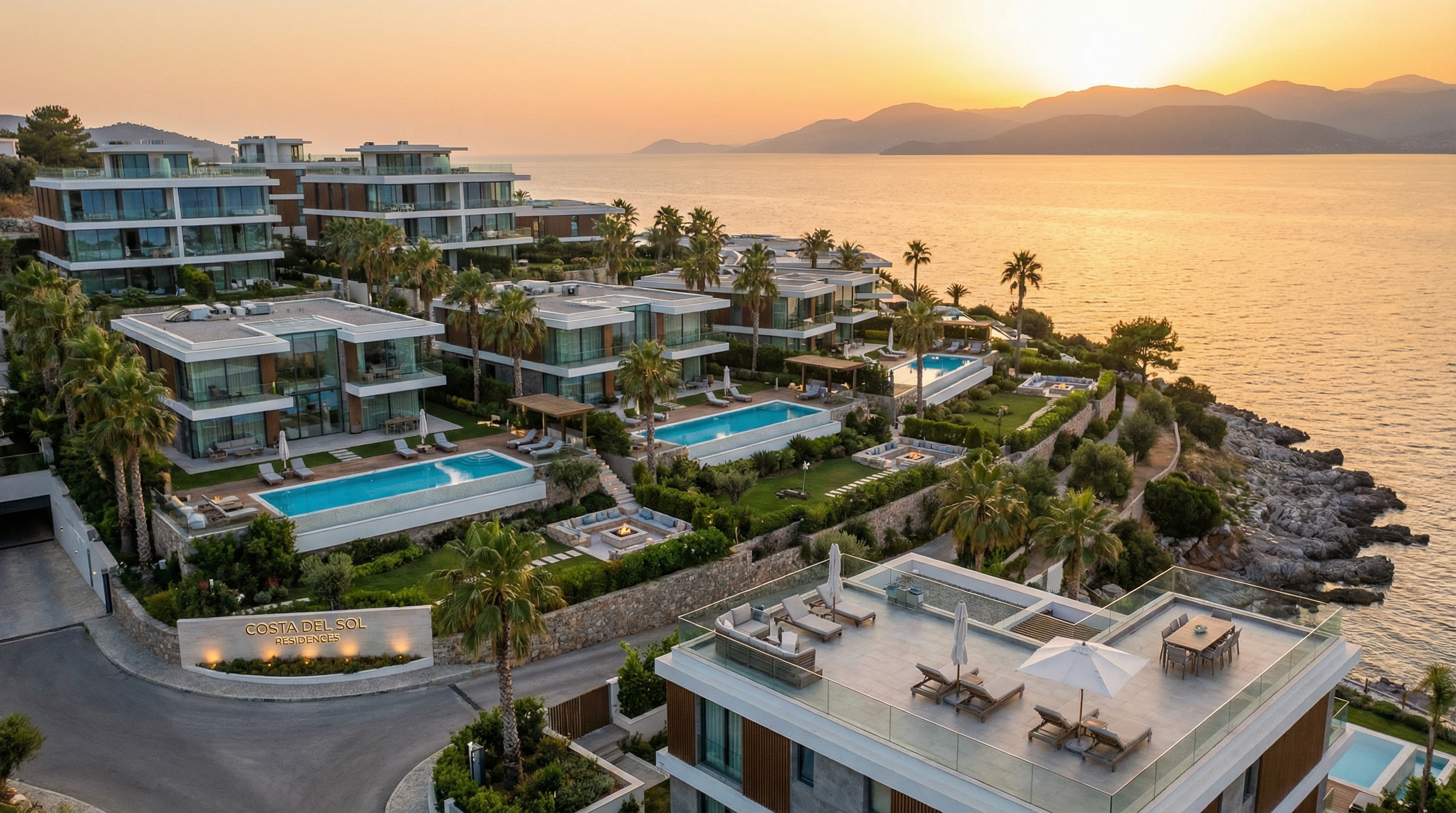
We’ve spent years helping international families compare iconic branded residences with exceptional traditional villas and apartments from Marbella to Estepona.Both paths can be brilliant—if you match the property to your lifestyle and exit plan. In 2026, choice has never been broader: hotel-branded beachfront suites, designer-serviced residences, and bespoke villas minutes from Puerto Banús.Below, we demystify the brand premium, outline true costs, and share the framework we use with clients to decide—with clarity—what’s better for you.
What exactly are branded residences in Costa del Sol?
Branded residences are homes linked to a hotel, designer, or lifestyle brand, offering managed services, curated amenities, and consistent standards. In Costa del Sol, you’ll find hotel-branded beachfront residences, golf-branded villas, and designer-led apartment communities near Marbella’s Golden Mile and Benahavís.The concept pairs private ownership with concierge living and resort-grade facilities.
Typically, there’s a brand/management agreement with the community, setting service levels, design control, and long-term maintenance standards. Amenities often include staffed lobbies, residents’ clubs, spas, valet, and in-residence services. For buyers who want turnkey ease, the appeal is obvious: consistency, prestige, and a lifestyle you can “switch on” whenever you land at Málaga.
By contrast, traditional luxury homes range from contemporary villas in gated communities to boutique beachfront apartments with lower monthly fees and more personal freedom. They may not have a global name on the door—but the best addresses carry their own prestige, and well-run communities can rival hotel-level operations.
Branded vs. traditional: where the real differences lie
In our experience, the distinction comes down to standardization and service. Branded residences deliver predictable quality and hospitality-grade convenience, while traditional homes give you individuality, privacy, and often better net holding costs. Your decision hinges on how much you value hotel-style living versus autonomy.
Expect a brand premium, more comprehensive service menus, and strict design guidelines that protect look and feel. Traditional properties can offer larger plots, bespoke design choices, and fewer restrictions. On community costs, branded residences often run higher due to staffing, amenities, and branding/technical fees; traditional homes usually carry lower monthly dues.
If you foresee frequent short stays and prefer light-touch ownership, a branded community may suit you. If you plan long stays, want a garden and space for customization, and dislike uniform rules, a stand-out villa or boutique development can be optimal—and often yields better long-term cost efficiency.
Are branded residences worth the premium in 2026?
We’ve seen brand premiums of roughly 10–30% over comparable new-build luxury properties, depending on location, operator strength, amenities, and scarcity. Whether it’s worth paying depends on your use profile, resale horizon, and tolerance for recurring costs. In prime, supply-constrained zones, the premium can be supported by stronger demand and better liquidity.
For lifestyle buyers visiting 6–12 weeks per year, the equation often favors branded: minimal hassle, concierge care, and rental readiness. For full/long-stay owners, traditional homes may deliver superior net value—especially where plots, privacy, and customization enhance long-term desirability without high monthly fees.
Crucially, not all brands or sites are equal. A beachfront, hotel-operated residence near Puerto Banús is different from a branded scheme far inland. Assess the operator’s track record, the service budget, and the resale audience. Protect your downside by prioritizing location, construction quality, and a transparent service-cost model.
How to evaluate branded vs. traditional: a practical, step-by-step method
Here’s the framework we use with clients to compare a branded residence against a top traditional alternative in the same budget and area. It balances lifestyle, risk, and exit value—so you can choose with confidence.
1) Run a full financial model (5–10 years)
Compare total acquisition costs (taxes, fees), monthly community charges, brand/management fees, insurance, and expected maintenance. Factor realistic rental income, voids, and local rules. Model conservative resale outcomes at years 5 and 10. We’ll build this side-by-side so you see net cost of enjoyment versus potential capital preservation.
- Include new-build VAT vs. resale transfer tax, plus stamp duty and mortgage costs.
- Stress-test interest rates and LTV if financing.
2) Legal and technical due diligence
For off-plan, verify bank guarantees, 10-year structural insurance, and delivery timelines. Confirm licenses and that common areas match the brochure. For resales, review community statutes, pending assessments, and any short-term rental restrictions. We coordinate with independent counsel for an airtight process.
- Bank guarantees for stage payments and decennial insurance are mandatory safeguards.
- Energy performance certificate required at sale.
3) Lifestyle test drive
Visit at peak and off-peak times. Time the drive to schools, beach clubs, golf, and health care. Sit in the lobby at 7 p.m.—is this your crowd? In a villa, check privacy lines, sun paths, and wind. We’ll arrange trial stays where possible to experience “a week in your future.”
- Assess noise, traffic, and service responsiveness.
- Gauge the guest arrival experience if you plan to host friends or rent selectively.
4) Exit strategy and buyer pool
Who will buy this from you in 5–10 years? A branded unit needs a steady pool of brand-aware buyers; a traditional villa relies on location, architecture, and plot. We benchmark recent transactions and time-on-market data by micro-area to align your exit plan with reality.
- Prioritize prime micro-locations with limited new supply.
- Choose timeless design over trend-driven finishes for broader appeal.
Costs, taxes, and ongoing fees you should expect
Understanding the full cost stack is essential. In Andalucía, new-build purchases carry 10% VAT (IVA) plus stamp duty (AJD). Resales pay a flat 7% transfer tax (ITP). Add notary/registry, legal fees, and—if financing—mortgage-related costs. Confirm current regional rates, as AJD may vary by mortgage conditions.
Typical acquisition extras: notary/registry €1,500–€3,500; legal 0.5–1%+VAT; valuation €400–€1,000; mortgage arrangement fees if applicable. Non-residents often secure 60–70% LTV with rates linked to Euribor. Always verify latest averages and lending criteria.
Monthly running costs vary widely. Branded residences often budget €1,000–€4,000+ per month depending on unit size and staffing. Traditional luxury communities can range €250–€1,500 per month. Add utilities (€300–€800), insurance (€600–€2,000/year), and routine maintenance. For villas, landscaped gardens and pools add materially to annual costs.
If you plan short-term letting, review community rules and licensing (VFT registration) in Andalucía. Registration and compliance are mandatory, including guest ID reporting and minimum service standards. Some branded schemes prohibit holiday rentals; others provide a rental program. Check before you commit.
Market insights 2026: where the action is—and pricing reality
In Q1–Q2 2026, we see branded and high-end new-build clusters along the Marbella Golden Mile, Puerto Banús, Benahavís (La Quinta/El Madroñal vicinity), and Estepona’s New Golden Mile. Mijas and Benalmádena host select designer-led beachfront and hillside schemes with strong views and service menus.
Observed asking ranges this year: branded two- to three-bed apartments €1.2m–€3.0m; branded penthouses/sky villas €3m–€8m+; branded villas in serviced compounds €3.5m–€12m+. Top non-branded new-build apartments €700k–€2.5m; signature villas €2.0m–€8m+ depending on plot, sea views, and access.
Macro tailwinds remain: robust foreign-buyer demand, limited prime land, and improved air connectivity via Málaga-Costa del Sol Airport. Monitor mortgage trends and household income dynamics for demand sensitivity at higher price bands. For official lending and activity data, we reference Spain’s central bank and registry statistics.
Resale performance and liquidity: do branded properties sell faster?
Short answer: sometimes—but not always. In our transactions, brand, operator quality, and address matter more than the logo alone. Beachfront and Golden Mile-proximate branded units with full-service offerings tend to attract a broader global pool and can transact more quickly in balanced markets.
However, elevated monthly fees or strict usage rules can narrow the buyer audience. A spectacular, well-sited traditional villa with timeless architecture and low carrying costs can outperform many branded units on resale. Your best hedge is choosing scarce micro-locations, enduring design, and transparent community finances—brand or no brand.
When we model exits, we avoid assuming a “brand lift” unless supported by recent local comparables. Liquidity is a function of price-to-quality, competition at your price point, and macro conditions. We’ll show you 5-year resale pathways under base and stress scenarios to align expectations with reality.
Expert tips: prestige without blind spots
After guiding 500+ international families, here’s how we help clients win on both lifestyle and logic:
- Buy the address first, the brand second. Micro-location is your insurance policy.
- Insist on a 5–10 year service budget with line items—staffing, reserves, brand/tech fees.
- Favor proven operators with on-site presence over “light touch” branding.
- Audit construction quality: warranties, acoustics, MEP design, and maintenance access.
- If renting, confirm licensing and community policy in writing.
- For financing, lock terms early and stress-test rates and exit values.
- Keep emotion in check: compare 3 direct substitutes side-by-side.
Conclusion: choosing with clarity in 2026
Sitting at a Puerto Banús café, we often tell clients: buy the lifestyle you’ll truly use and the location future buyers will fight for. Branded residences deliver effortless living and prestige—at a known premium and higher monthly costs. Traditional luxury homes give you individuality, space, and often stronger net economics.
We’ll help you compare apples-to-apples: full cost models, legal safeguards, rental and exit strategies, and on-the-ground testing of each address. When you’re ready, we can shortlist three best-fit options—one branded, one traditional, and one hybrid—so your decision is confident, data-backed, and deeply personal.
Buyer decision matrix
| Factor | Why it matters | What buyers should verify |
|---|---|---|
| Everyday use | The home must work outside holiday weeks. | Access, services, noise, parking, running costs and year-round comfort. |
| Resale | Practical use supports future demand. | Location, maintenance, rules, energy and local activity. |
| New build | Specifications shape comfort and costs. | Orientation, shade, ventilation, shared facilities, handover and aftercare. |
Local buyer context
Investment value needs realistic use, documented costs, demand, rules and a clear exit route.
A buyer comparing London, Belfast, Dublin, Manchester or Amsterdam routes usually weighs flight rhythm, family visits, remote work and quieter-month practicality.
For new builds, connect the topic with licences, payment plan, materials, shared facilities, handover and aftercare.
New-build focus: For new builds, connect the topic with licences, payment plan, materials, shared facilities, handover and aftercare.
