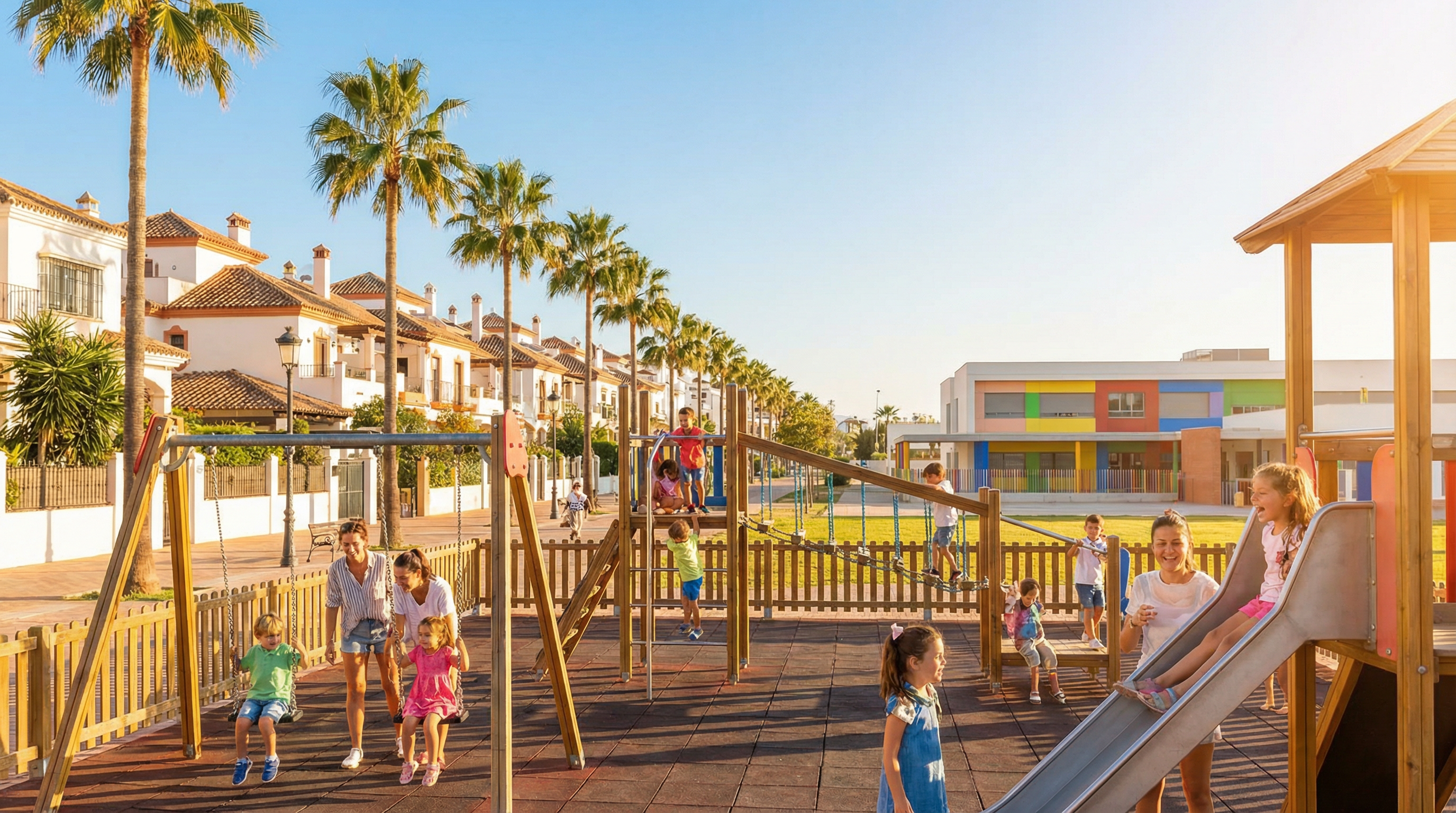
Thinking about moving your family to the sunny Costa del Sol? One of the biggest decisions you'll face is choosing the right school for your children. This detailed guide breaks down the pros and cons of international and Spanish schools to help you make the best choice for your family.
International vs. Spanish Schools in Costa del Sol: Which is Best for Your Children?
So, you’re dreaming of golden beaches, delicious tapas, and a relaxed lifestyle under the Spanish sun. The Costa del Sol, stretching along Málaga’s coastline, is an incredibly popular destination for families from all corners of the globe. From the glamorous streets of Marbella to the charming Old Town of Estepona and the vibrant city of Málaga itself, this region offers a fantastic quality of life.
But when it comes to relocating with children, one question often dominates the conversation: “Which school is best for my kids?” This isn't just about finding a good school; it's about finding the right school for your family’s unique needs, your children's learning style, and your long-term goals. Do you lean towards an international school with a familiar curriculum, or embrace the Spanish education system fully? Let's dive deep into the world of education in the Costa del Sol to help you navigate this important decision.
Understanding Your Options: A Tale of Two School Systems
The Costa del Sol offers two primary types of schooling for expat families: International Schools and Spanish Schools (both public and private). Each has distinct characteristics that can significantly impact your child's experience and future.
International Schools in the Costa del Sol: A Familiar Path for Expat Families
International schools are often the first choice for families who are planning a temporary stay or want to maintain a connection to their home country's education system. The Costa del Sol is home to a robust selection of these, particularly in areas with high expat populations like Marbella, Benalmádena, and Fuengirola.
Pros of International Schools
- Familiar Curriculum: Many international schools follow British (e.g., IGCSE, A-Levels), American, or International Baccalaureate (IB) curricula. This familiarity can ease the transition for students and make reintegration into a home country's system smoother if you decide to move again. For example, the Aloha College in Marbella offers both British and Spanish Bachillerato.
- Language of Instruction: The primary language of instruction is typically English. This is a huge advantage for children who are not yet fluent in Spanish, allowing them to continue their studies without a significant language barrier.
- Diverse Student Body: These schools boast a truly international mix of students and teachers from dozens of nationalities. This fosters a highly multicultural environment, broadening horizons and encouraging global awareness.
- Excellent Facilities & Resources: Many international schools are well-funded and offer state-of-the-art facilities, including sports complexes, performing arts centers, and advanced technology.
- Smaller Class Sizes: Generally, international schools have smaller class sizes compared to Spanish public schools, leading to more individualized attention.
- Seamless Transition for University: Graduating from an international curriculum like IB or A-Levels often provides a straightforward path to universities worldwide, including those in the UK, USA, and other European countries.
Cons of International Schools
- Cost: This is often the biggest hurdle. International schools are private institutions and come with significant fees, often ranging from €8,000 to €25,000+ per year, excluding registration, uniforms, books, and extracurriculars. For instance, reputable schools in Marbella like the Marbella Montessori School or Marbella New College will have fees towards the higher end.
- Limited Spanish Immersion: While many offer Spanish lessons, the day-to-day immersion in Spanish culture and language is naturally less intense than in a local Spanish school. Your child might learn Spanish as a subject but may not become fully fluent in its natural context.
- Potential "Bubble": It's possible for families to live in an expat "bubble," primarily interacting with other expats and not fully integrating into local Spanish life.
- Commute: Depending on where you live, the commute to a specific international school can be substantial, as they are not as widely distributed as national schools.
Spanish Schools in the Costa del Sol: Embracing Local Culture and Language
Spanish schools offer a different, equally valid, and often more immersive experience. They are divided into Public (Público) and Private (Privado) / Semi-Private (Concertado) institutions.
Pros of Spanish Schools (Public & Private/Concertado)
- Full Language & Cultural Immersion: This is the strongest advantage. Your children will quickly become fluent in Spanish, not just academically but culturally. They will make Spanish friends, understand local customs, and truly become part of the community.
- Cost-Effective:
- Public Schools: Tuition is generally free for residents. You will only pay for books, materials, extracurriculars, and potentially a school lunch program.
- Concertado Schools: These are privately run but partially subsidized by the state, keeping fees much lower than international schools (typically €100-€500 per month, including some services).
- Strong Community Integration: Attending a local school means your family will naturally integrate into the local Spanish community, meeting Spanish parents and forging local connections.
- High Academic Standards: The Spanish education system is known for its rigorous academic curriculum, particularly at the secondary level. Many public high schools (like IES Vicente Espinel in Málaga, often called "Gaona") have excellent reputations.
- Accessibility: Public schools are numerous and widely distributed, making it easy to find one close to home regardless of whether you're in a city like Málaga or a smaller town like Estepona.
Cons of Spanish Schools (Public & Private/Concertado)
- Language Barrier for New Arrivals: For children with no prior Spanish, the initial months can be very challenging. While younger children (under 8-10) typically adapt quickly, older children may struggle more. Some schools offer "aulas de acogida" (welcome classes) for non-Spanish speakers, but this support varies.
- Curriculum Difference: The Spanish curriculum (LOMLOE - Ley Orgánica de Modificación de la LOE) can be very different from what children are used to, especially in subjects like history and literature, which focus heavily on Spanish and European contexts.
- Large Class Sizes: Public schools often have larger class sizes than international schools, especially in popular areas. Classes can reach 25-30 students or more.
- Less Diverse Student Body: While there will always be some diversity, the student population will predominantly be Spanish.
- Less Focus on Extracurriculars: While improving, Spanish schools traditionally place less emphasis on a wide range of extracurricular sports, arts, and clubs compared to international schools, often leaving these activities to be done outside of school hours.
- Bureaucracy: Enrolling in public schools can sometimes involve more bureaucratic hurdles and specific catchment area rules.
Key Considerations for Your Family
Now that we’ve outlined the basics, let’s dig into the crucial factors you need to weigh when making your decision.